

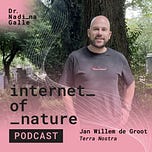

Prefer a different platform? Listen on Spotify or Apple Podcasts.
A few weeks before we recorded this episode, Amsterdam’s leading daily newspaper, Het Parool, published a headline that felt quietly unsettling:
“Amsterdam’s trees haven’t grown in four years.”
The implication wasn’t dramatic. It was subtle. Something in the system isn’t working the way we assume it is.
When I asked arborist-turned-CEO Jan Willem de Groot what he made of the headline, he responded without hesitation.
“Of course trees grow,” he said. “But they are not growing as much as they should.”
The pause after that sentence was heavy. Not hopeless — just honest. Trees are alive in Amsterdam. But too many are living in a state of survival, not development.
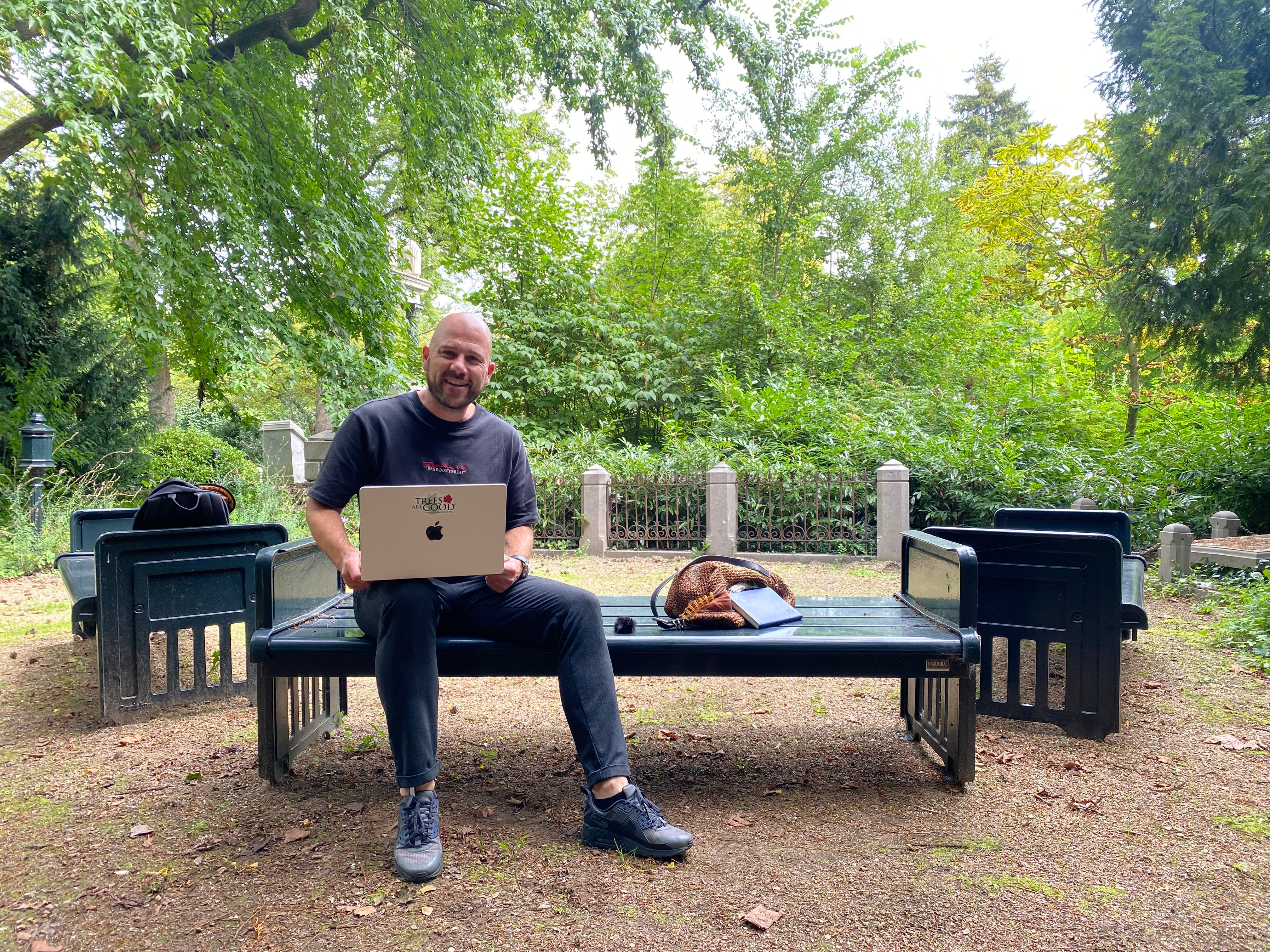
We had tried to record this conversation in Amstelpark, but the playground was bursting with back‑to‑school energy — laughter, shouts, bicycle bells — a soundtrack of a city very much alive. So we crossed the street to Zorgvlied Cemetery, where the sound softened and the air shifted. We found a bench beneath a mature plane tree whose crown stretched wide enough to shelter the whole path.
First time recording the podcast in a cemetery, but it was the right place for this conversation.
From chainsaws to stewardship
Jan Willem didn’t start as a consultant. He started in the trees — literally — climbing them.
He grew up close to forests, birdwatching with his father and brother on weekends. It led him to study forestry, but when he graduated in the 1990s, there were almost no jobs in ecological work. So he became a gardener, then a tree climber, then certified as a European Tree Worker.
He laughed, remembering those early days:
“In my classroom, we talked more about chainsaw brands than about ecology. Husqvarna or Stihl — that was the debate.”
At that time, the work culture centered on removal — efficiency, adrenaline, clean cuts.
But slowly, his attention shifted. He began consulting, first under peers, then on his own. He began to notice something his early training had missed:
“We didn’t talk about what trees give. We didn’t talk about the ecosystem they create around themselves.”
The chainsaw mattered less. The crown mattered more.
Today, as CEO of Terra Nostra, one of the Netherlands’ largest tree consultancies, he leads a team of 20 tree consultants working with municipalities across the country. Their job is simple in principle but complicated in practice: keep trees alive long enough to become old.
Why large trees matter more than we think
This year, Terra Nostra is preparing more tree transplants than ever before.
Not replanting saplings. Transplanting mature trees.
This is expensive. It is logistically intense. It requires cranes, planning, patience — and often political will.
So why do it?
Because large trees provide orders of magnitude more benefit than young ones:
They cool streets during 30°C days when shade is survival, not luxury.
They intercept stormwater that would otherwise overwhelm drains.
They produce significantly more oxygen.
They store far more carbon because carbon storage scales with size.
They create habitat: cavities for birds, shade for insects, and structure for entire food webs.
Jan Willem put it plainly:
“A mature tree shapes how a neighborhood feels. A sapling can’t do that yet.”
You don’t just plant a tree. You grow one.
Crown volume > number of stems
For decades, city planning used a simple arithmetic logic:
Remove one tree → Plant one tree.
This is known as the boom-balans — the tree balance.
But Jan Willem showed how deeply misleading that metric is.
“A hollow trunk is seen as damage. But for birds, it is a home.”
The shift now happening across Dutch municipalities is toward Tree Balance 2.0, which measures crown volume — the true living, functioning mass of a tree.
Think of crown volume as:
a three-dimensional balloon of leaves and branches,
where the cooling, carbon storage, shelter, and rain interception actually happen.
When you calculate crown volume, one reality becomes unavoidable:
Removing a single mature tree often requires 50 to 100 saplings to replace the ecological function.
City planners understand numbers. This changes the conversation.
“Once you show the volume loss,” Jan Willem said, “people decide to keep the tree.”
The data reinforces what the eye knows, and the heart already understands.
On risk, value, and the courage to let trees be wild
Urban trees are often judged by risk assessments — leaning, hollow, fungal, “untidy.”
But these so‑called “defects” are frequently markers of ecological richness.
Dutch cities like Arnhem (about 180,000 people) are now avoiding the word risk altogether, because the statistical likelihood of tree‑related injury is tiny compared to the scale of ecological harm when we over‑sanitize.
“We sterilize landscapes in the name of safety,” Jan Willem said, “and in doing so, we remove the places where life can flourish.”
To support biodiversity, we must allow imperfection.
Some trees should look wild.
Some branches should fall.
Some bark should crack.
Life requires rough edges.
So the question becomes: How do we care for these imperfect, valuable trees at scale? How do we know when to intervene—and when to let them simply be?
That’s where the next part of our conversation turned.
Smart Tree Management: technology that serves care
Terra Nostra has launched a multi-year pilot with greehill, a technology company that has led LiDAR-based urban tree scanning projects in cities from Singapore to Pittsburgh, Malmö to Lyon. The goal is simple, but transformative:
Collect accurate, city-wide tree data fast enough — and precise enough — to make better decisions.
Here’s how the system works:
An electric car equipped with a LiDAR scanner drives through the city.
The scanner emits 2.8 million laser points per second, capturing trees up to 400 meters away.
High-resolution photos are taken at the same time.
All of that becomes a point cloud — a digital twin of every tree.
This allows municipalities to measure:
Crown volume
Stem diameter (AKA DBH)
Tree height
Lean angle
Canopy density
And the exact location of each tree
At a scale that was previously impossible.
Where a traditional inventory team might record 150–200 trees a day, greehill’s system can assess thousands — and do it with greater accuracy.
More importantly, this data does not replace arborists.
It frees them.
“Most trees are healthy,” Jan Willem said. “Experts should spend their time on the few that truly need attention.”
Large-scale data collection is only useful if it serves care — if it lets tree experts focus their attention where it matters, and lets cities plan based on what trees actually need, not what we assume.
The 70% we rarely discuss
Reality check: smart tree inventories help us understand what cities manage. But most of the urban forest isn’t managed by cities at all. Around 70% of the canopy in Amsterdam is on private land. This statistic reflects the public–private split of the urban forest in cities worldwide.
Private land means… Courtyards. Canal gardens. Cemeteries. Schoolyards. Company campuses. Trees you can’t necessarily see from the street, but that shape the daily lives of the people who live beside them.
And yet, over 90% of requests to remove private trees are approved (as my own research showed in the Het Parool opinion piece published last January).
We cannot out-plant this loss.
We cannot offset it.
We cannot “push shade to the suburbs” through free sapling giveaways and call it progress.
If we want cities that stay livable under rising heat, we need to radically protect the mature trees we already have.
That means:
policy that discourages unnecessary removals
incentives that reward long-term care
and stories that help people see the tree outside their window differently
Because once someone has a relationship with a tree — they don’t just live near it.
They protect it.
Trees as memory and meaning: a lesson from Ukraine
Recently, Jan Willem traveled to Ukraine to speak at a tree conference. His family urged him not to go. The war was close; the sirens unpredictable. But he went.
The invitation came through loss. In June 2023, Semen Oblomei, a 22-year-old studying to become a tree surgeon, was killed in an aerial strike. In his memory, his sister founded the Semen Oblomei Foundation, dedicated to advancing tree care in Ukraine. Even in war, a professional network is growing—learning, adapting, preparing to rebuild.
Jan Willem visited Kyiv, Irpin, Bucha, and Lviv. He met arborists working under conditions many of us can hardly imagine—yet still caring for trees.
In Kyiv and Lviv, he walked through what they call the Lanes of Heroes: rows of trees planted for those who have died.
Not monuments.
Not plaques.
Trees.
Each one: a name, a date, a life.
Jan Willem told me:
“These trees gave people hope. They were living reminders of someone worth remembering.”
He had gone to speak about tree protection during reconstruction.
He returned with a different lesson:
Trees are not just infrastructure.
They are memory.
They are continuity in places where life has been broken.
This is where data reaches its limit.
A LIDAR scan can measure height, diameter, crown volume.
But it cannot tell you:
who planted the tree,
whose absence it holds,
who returns to touch its bark when they need strength.
No ecosystem services model calculates grief.
No satellite maps devotion.
We protect what we love.
And we love what we know.
What the Internet of Nature means here
The IoN is often described as sensors, data, and digital twins — and yes, those tools matter. But here, it means something quieter and more human:
The network of relationships that keeps trees standing.
It is the link between:
the data that shows a crown is worth keeping,
the professional judgment that knows how to care for it,
and the community that chooses to fight for it.
It is the understanding that technology does not replace care — it supports it. It gives us clarity, not permission. It helps us act, not automate.
As we packed up the microphones in Zorgvlied, the afternoon light caught the edges of the plane tree’s crown — wide, confident, unhurried.
Cities often speak of planting for the future. But the future is already here — standing in narrow tree pits, shared garden yards, school playgrounds, canal edges, old industrial lots now going to seed, and in the quiet rows of cemetery avenues. The unseen forest that lives where our lives unfold.
Our work now is not only to plant. It is to keep what has already grown. To measure wisely. To intervene gently. To let trees reach maturity, rather than restarting the clock again and again.
Most of this will not happen in grand policy moments. It will happen in small, ordinary decisions:
Neighbors refusing to accept a default removal notice — and commissioning a second, independent assessment that keeps the trees standing.
A developer reshaping the layout of a new neighborhood to build around the old trees — recognizing that maturity cannot be replanted.
A municipality receiving not just ecosystem service calculations, but letters — handwritten, heartfelt — asking to let a tree stay.
This is how an urban forest endures. Not all at once. But tree by tree.
Happy trails,
Nadina
Prefer a different platform? Listen on Spotify, Apple Podcasts, or wherever you get your podcasts.


