

Field Note 15: Why Things Snowball — And Why That’s the Most Hopeful Thing About Our Planet’s Future
Sitting down with Tom Crowther on feedback loops, grounded hope, and why nature wants to heal — ahead of his new book, Nature's Echo, out June 2!
When Tom Crowther’s manuscript landed in my inbox a few months ago, I cleared a weekend to read it. I expected to like it. I didn’t expect it to follow me around for weeks afterwards. An echo, you might say.
Tom has been on Internet of Nature Podcast twice — once in 2022 for the work coming out of his lab on global restoration, and once more recently as a friend who happens to be one of the most original thinkers I know.
Read more👇

Nature’s Echo is the book he’s been working towards his whole career. It’s the one that sits underneath all of it — the science, the controversy, the comeback. And it’s a book about feedback loops: the self-reinforcing patterns that built our universe, that shaped life on this planet, and that — Tom argues — could just as easily build the recovery as they have the collapse.
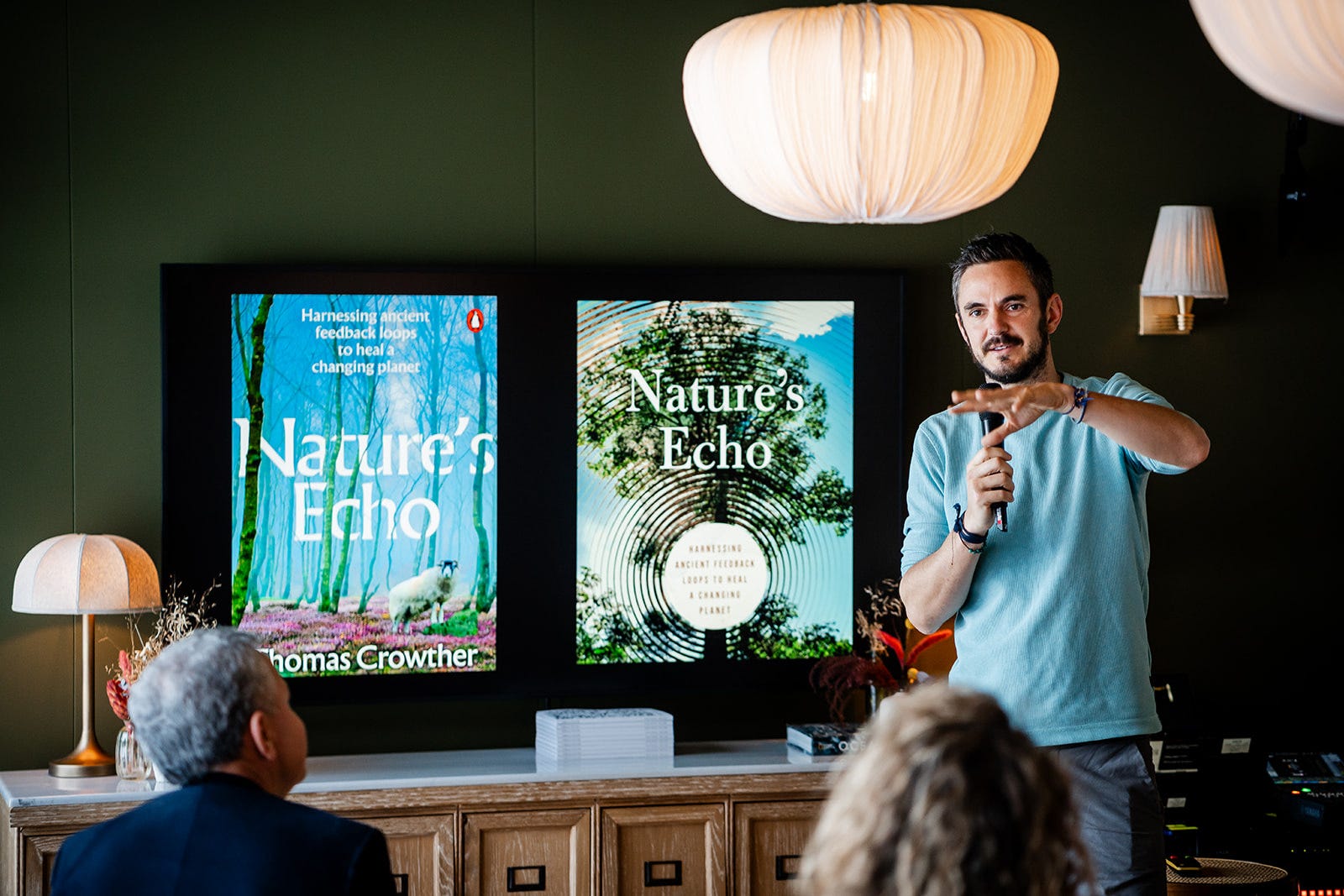
You probably know the trillion trees story. In 2019, Tom and his colleagues published a paper in Science showing that Earth could potentially support an additional trillion trees. The finding was real. The headlines were not. “Plant a trillion trees to save the world” became the soundbite, and the firestorm that followed nearly broke him. The book opens with that wreckage, and it spends the next 280 pages building something extraordinary out of the ash.
Here’s the blurb I wrote for him:
“There is no other book like this. Nature’s Echo is rigorous without losing you, hopeful without deceiving you, and full of the kind of stories that anchor the science so deeply you won’t soon forget them.”
I sent him ten questions about the book. His answers are below, lightly edited.
Tom, I tried to summarise Nature’s Echo in one sentence: “Nature’s Echo is a book about why things snowball — and why that’s actually the most hopeful thing about our planet’s future.” What do you think — would you change anything?
No. I guess the message has evolved as we have received feedback from readers. My favourite description is: “This book is a scientific basis for environmental optimism, showing how the patterns that created our universe can also drive our planet towards regeneration, if we can only allow them to.”
Feedback loops are the self-reinforcing patterns that formed the stars after the Big Bang. They are the same patterns that allowed life to proliferate on an otherwise barren and uninhabitable planet, as life created the conditions for more life to thrive. They are currently spiralling out of control as humans continue to exploit and grow.
But these patterns can easily be steered towards regeneration — whenever rural livelihoods are improved by nature recovery, or when people prefer the health, wealth, fun or fashion benefits that come with regenerative solutions. When we find the solutions that make regeneration the preferable option for people, you cannot stop it from growing across the globe.
In 2019, a paper you co-authored went viral for all the wrong reasons — reached 60 million people, led to Trump planting trees on the White House lawn, accusations of ecocide, and your career in freefall. The trillion trees “firestorm” nearly broke you. Do you think the scientific community is actually equipped to handle the feedback loops of social media, or are we sending scientists into a battle they’re not trained for?
This is a great question. And my simple answer is “no.”
Scientists are expected to share their knowledge as widely as possible. But when society takes notice, we are so often unprepared for the consequences. There is a classic tension in science communication: to gain attention, the message needs to be simplified, even though scientific accuracy is often context-dependent. In my case, I wanted governments to distribute wealth to the millions of rural land stewards to supercharge their efforts to revitalise biodiversity and improve their own well-being. But the message spreading across the headlines was “plant more trees to save the world.”
I was convinced that I would get a chance to explain the message. But the more people talked about those simplified messages, the bigger the story grew, which only made more people talk about it. It was painful to see this feedback loop spiralling beyond my control. Somehow, scientists need the space to provide a catchy headline, but also to present the context that explains the meaning, before the spiral of one-liners distorts our version of reality into something else entirely.
The book moves from the Big Bang, to a pontine stroke suffered after a cliff jump gone wrong, to twelve jaguars reintroduced into an Argentinian wetland. At what point did you realise that was actually one big story?
That is also a great question. When I started writing the book, I was planning to focus on the power of feedback loops in ecological restoration. When nature recovery improves people’s livelihoods, then it incentivises more nature protection and so on. Through this reinforcing loop, you can imagine how nature can spread across entire landscapes.
But as I looked into these patterns, I could see parallels in my everyday life. They are happening all around us, at all times. Once you start seeing them, you can’t stop seeing them everywhere. And in fact, they are the reason for every major force of change that our universe has ever seen.
Somehow, this gives me even more optimism — because once these loops gain momentum, they are unstoppable. And if we can build this kind of momentum with regeneration, then global recovery stops being a pipe dream. It becomes an inevitability.
Martin van Buren — a bluebottle fly you named after the 8th president of the United States — somehow ends up being one of the most effective teachers in a book about planetary collapse. Why? And did you know when he climbed into that car that he was going to make the book?
I didn’t realise that Martin would make it into the book until I started writing it. Martin was a fly that snuck into our car on a road trip from Las Vegas to Yosemite. He/she was a hilarious little character, with a furry body and eager personality. We wanted to release Martin, but we were already deep in the Mojave Desert and figured it would not be very comfortable. So we were waiting to release Martin in a more comfortable environment.
This made us take extra notice of the environment changing as we drove along. Our journey gave a really striking example of how rapidly ecosystems shifted from one state to another. From desert, to grassland, to forests — feedback loops cause ecosystems to tip rapidly between states. And those are exactly the same feedback loops that threaten to tip our entire planet into a new state, unless we notice them and work with them, rather than fight against them.
You name Restor as the thing that finally felt like enough. How so? Why has it been? Is it still?
When I was a kid, I was desperate to help global restoration, but I had no idea how to engage. As I grew up, I was told that restoration was hopeless and that there was no point in engaging. However, as my scientific career progressed, I began to realise the astonishing potential of nature restoration across the globe and how simple it can be when it works.
For me, the biggest shame in the environmental movement is that no one seems to know about the incredible movement that is silently building momentum around the world. There are billions of rural people across the globe who are desperate to revitalise their landscapes, to improve their own livelihoods and well-being. They know how to do it. But they often lack the finances needed to get going, and they do it all alone — invisible to the markets that benefit the rest of the world.
If we could all see these environmental heroes directly, we could engage with them by buying their goods or visiting their ecotourism projects. For me, Restor.eco is the answer to this need. Like Google Maps for nature, Restor lets anyone, anywhere, see the global restoration movement, with millions of local projects across hundreds of millions of hectares. As more of us start to notice these incredible projects and allow finance to gradually flow towards them, the feedback loops of global restoration can grow with astonishing momentum, changing our entire planetary trajectory.
Costa Rica pays farmers for scenic beauty and has doubled its forest cover. That feels like one of the most radical ideas in the entire book — is it replicable in other places, or is Costa Rica a beautiful exception?
There are millions of examples around the world where nature recovery has improved the economic stability of people. When you see that happening, you start to realise the potential of nature to spread. But Costa Rica is incredible because it proved that this can also be the case at a national scale.
By the 1980s, Costa Rica had fallen to 25% natural tree cover as land was cleared for grazing. But instead of allowing that trend to continue, they distributed less than 0.1% of their national wealth (from a tax on fossil fuels) to rural farmers to compensate them for protecting nature. Over the next 30 years, the natural vegetation cover has rebounded amazingly — over 60% according to some estimates. At the same time, the national economy has stabilised and improved as nature and sustainability have become baked into the cultural identity of the country.
This year, a researcher on our team (Giacomo Delgado) has been using bioacoustics to record the soundscapes of nature, showing that the country’s biodiversity has been recovering as the country becomes objectively more beautiful. Costa Rica is proof that there is no trade-off between people and nature. Both can thrive and recover together.
You argue that joy — not guilt — is the most powerful fuel for environmental action. A lot of people are going to push back on that. Make the case for joy.
It is hard to gain intrinsic motivation for things that feel like obligations or chores. If we act out of guilt, our actions can make a difference, but those impacts are often limited because it is difficult to build momentum and repeat them. However, when people find genuine joy and enthusiasm for the environmental solutions that nourish them, it becomes easier to build positive feedback loops, because the joy makes it easier to do it again. And the more you do it, the more enjoyable it becomes.
I believe the challenge that we face as individuals is not to figure out which actions we should do. It is to identify which regenerative options bring us the most joy. Once we find those solutions, then engagement becomes easier and easier, as others around us start to join in. We have seen upward spirals like this in every aspect of psychology and spirituality. And I believe these basic principles are vital for unlocking our full potential in the environmental challenge too.
But also — is there a version of this book you couldn’t write? The one where the feedback loops don’t tip in our favour. How close to that version are we actually living?
That is true. Feedback loops can grow in literally any direction. And this is the thing that scientists are most scared of. They can tip our planet into an entirely new state, as warming and biodiversity loss amplify one another into a planetary spiral. The scary thing is that we simply have no idea whether those new conditions would be conducive to human life on this planet. In the past, whenever a single group of organisms built feedback loops that tipped the entire planet into a new state, the resulting conditions were not favourable for those species that had done well in the previous environment. We are in danger of doing the same with our planet if we continue to exceed our planetary boundaries.
But in all honesty, we simply don’t know which feedback loops will grow into tidal waves of change. The only thing we do know is that feedback loops amplify the qualities of what we put into them. If we feed them only fear and anxiety, then those are the qualities that will be amplified. But if we can somehow find a way to face our environmental challenges with enthusiasm for the opportunities of a brighter future, then those qualities can also grow throughout our vastly interconnected human societies.
You’ve spent your career trying to get people to care about what they can’t see — soil microbes, mycorrhizal networks, arctic carbon stores. What’s the one invisible thing you most wish people could see?
Coral reefs. We watch films like Avatar and marvel at the wonder of the creation. But there is more intricate beauty in every natural ecosystem. And coral reefs just feel like the most abundant version of that — because they are an explosion of life, colour and magic. Yet these fragile systems are on the brink of disappearing.
If everyone could experience a flourishing reef first-hand, you could not deny the magic of life on our planet. We have to appreciate them while they are here. Hopefully, witnessing this firework display of life and colour would inspire more efforts to protect them.
You end the book with feedback loops that echo long after we’re gone. What loop do you most hope Nature’s Echo itself sets in motion?
Great question.I wish people could witness first-hand the overwhelming benefits that accumulate when nature is allowed to flourish. For almost all technological or geoengineering solutions, we are always managing trade-offs. One thing comes at the expense of another. But when nature is allowed to rebound in rural settings, it sparks a range of revivals across social, psychological, financial, cultural, and ecological realms. When you experience rural communities benefitting from ecological revival, you cannot help but find room for hope and optimism.
Like all other things in our universe, our species is only here temporarily. Our moment of existence is bookended by billions of years of non-existence. But in this brief window of time, witnessing the overflowing joy of ecological revival is something that I wish everyone could experience. If that were to happen, I have no doubt that our future would be a more beautiful and compassionate one.
Pre-order Nature’s Echo
“Filled with intriguing and wide-ranging case studies of how individuals can be agents of change, this empowers and inspires.” — Publishers Weekly
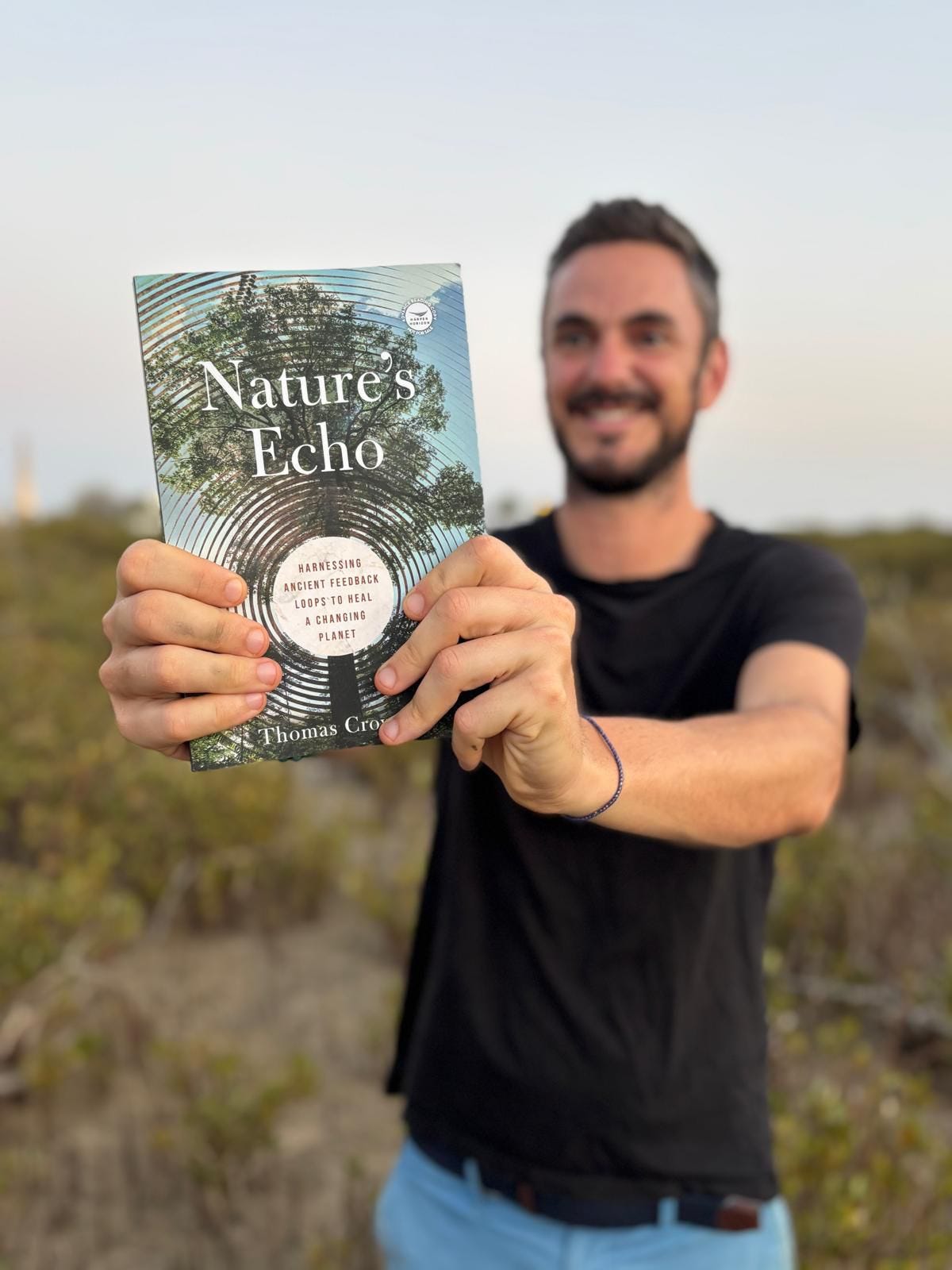
Nature’s Echo: Harnessing Ancient Feedback Loops to Heal a Changing Planet is published by Harper Horizon (US) on June 2, 2026 ($29.99 hardcover) and by Torva / Penguin (UK) on June 4, 2026 (£22 hardback). Ebook and audiobook (read by Tom himself!) editions are available in both regions.
Pre-order (US):
Pre-order (UK):
Or better yet! (Pre)order it at your local independent bookshop.
If this resonates, share it with a friend who could use a reason to be hopeful about the planet without abandoning their grip on reality. There aren’t many books that earn that, but this is one of them.
Happy trails,
Nadina